Official Title: Evaluating the Feasibility, Acceptability and Preliminary Signals of Effect of Two Delivery Models for the Implementation of a Community-Based Maternal Mental Health Programme for Perinatal Depression in Sri Lanka: A Pilot Study

Improving Maternal Mental Health Through Community-Based Care
Perinatal depression (PND) affects approximately one in five mothers in Sri Lanka, making it one of the most common mental health conditions experienced during pregnancy and after childbirth. When left untreated, PND can have lasting effects on the emotional, physical, and social well-being of mothers, while also influencing infant development, family relationships, and long-term child outcomes.
Although effective psychological interventions are available, many women in Sri Lanka still face barriers to accessing timely mental health care. Limited specialist resources, stigma surrounding mental illness, and challenges in delivering services within community settings contribute to a significant treatment gap.
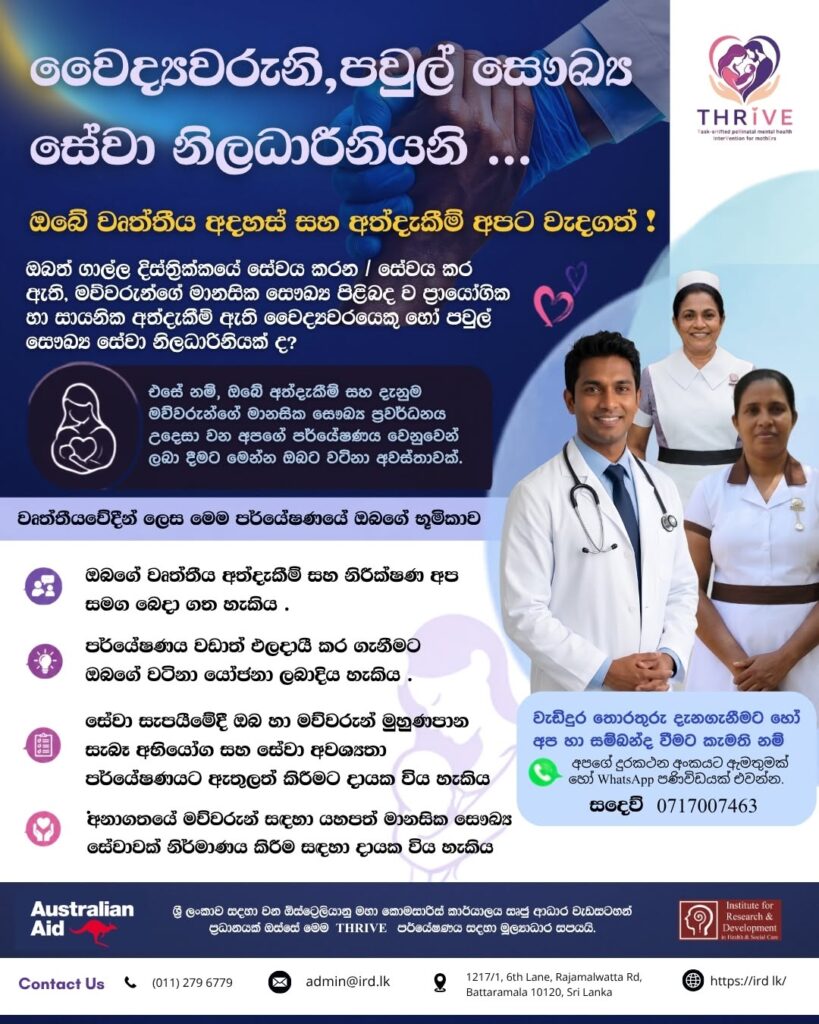
THRIVE addresses these issues by investigating task-shifted care, where trained community-level personnels deliver structured community-based maternal mental health intervention called Thinking Healthy Program (THP) to perinatal depression mothers.
As a pilot study, THRIVE evaluates the feasibility, acceptability, and preliminary signals of effect of two different delivery models for implementing THP in Sri Lanka.
- Delivery by the primary healthcare doctors
- Delivery by public health midwifes
The findings will provide valuable evidence to inform larger-scale implementation and support the integration of maternal mental health services into routine healthcare systems.
About the Intervention: The Thinking Healthy Programme (THP)
The Thinking Healthy Programme (THP) is an evidence-based psychosocial intervention developed in Pakistan to support women experiencing perinatal depression during pregnancy and the first year after childbirth. The THP has been proven effective when implemented by non-specialist providers, including LHWs and PVs, in rural Pakistan The programme uses principles of Cognitive Behavioural Therapy (CBT) to help mothers recognize unhelpful thinking patterns, strengthen problem-solving skills, build supportive relationships, and promote healthy behaviours that improve both maternal and infant well-being.
WHO has later endorsed the THP as the first line of treatment for PND, especially in LMICs making the programme particularly suitable for low-resource settings where access to mental health specialists is limited.
Prior to the THRIVE study, formative work conducted under the ENHANCE Sri Lanka project, identified the THP as a suitable intervention to address perinatal depression (PND) within the Sri Lankan context. Building on these findings, the THP has been co-adapted to align with the cultural context, healthcare system, and needs of communities in Sri Lanka.
Study Design & The Two Delivery Models
Project THRIVE is designed as a mixed-methods comparative pilot study based in the Galle District. Over a 15-month operational timeline (running from June 2026 to September 2027), the research team will evaluate, compare, and contrast two innovative frontline task-shifted implementation pathways to identify optimal infrastructure alignment:
- Model 1: Delivery by Public Health Midwives (PHMs) during routine home-based maternal care visits.
- Model 2: Delivery by Primary Healthcare Doctors integrated into facility-based primary medical clinics and units.
Project Timeline & Funding Architecture
- Duration: June 2026 to September 2027.
- Setting: Galle District, Sri Lanka.
- Funding Source: Generously funded and supported under the Colombo Direct Aid Program 2025-26.
Meet the Investigating Team
Project THRIVE is driven by an elite coalition of national and international clinical experts and mental health advocates:
- Co-Primary Investigator: Dr Oshini Sri Jayasinghe (Post-doctoral Research Fellow, IRD Sri Lanka)
- Co-Primary Investigator: Prof Athula Sumathipala (Director, IRD Sri Lanka; Professor of Psychiatry, Keele University)
- Co-Investigator: Prof. Harshini Rajapakse (Professor in Psychiatry, University of Ruhuna)
- Co-Investigator: Dr. Prasad Ranaweera (Regional Director of Health Services – Galle)
- Co-Investigator: Dr. Sudath Samaraweera (Deputy Director, IRD Sri Lanka)
- Co-Investigator: Ms. Hirudimalee De Silva (Research Assistant, IRD Sri Lanka)
- Co-Investigator: Dr Danuja Mahesh (Honorary Research Associate, IRD Sri Lanka)
- Senior Advisory Council: Prof. Atif Rahman & Dr. Siham Sikander (University of Liverpool)
- Key Collaborators: College of Specialist Family Physicians & The Governor of the Southern Province
Research assistants






This Reserch is funded by the Australian High Commission in Sri Lanka through a Direct Aid Program Grant.